收录于话题
#英语#新高考I卷
系列目录:
第一期:阅读理解(李子灏)
第二期:阅读七选五(林佳钰);完形填空、语法填空(陈泉)
第三期:写作(王飞翔)
一、试题解答
A
Bike Rental & Guided Tours
Welcome to Amsterdam, welcome to MacBike. You see much more from the seat of a bike! Cycling is the most economical, sustainable and fun way to explore the city, with its beautiful canals, parks, squares and countless lights. You can also bike along lovely landscapes outside of Amsterdam.
Why MacBike
MacBike has been around for almost 30 years and is the biggest bicycle rental company in Amsterdam. With over 2,500 bikes stored in our five rental shops at strategic locations, we make sure there is always a bike available for you. We offer the newest bicycles in a wide variety, including basic bikes with foot brake (刹车), bikes with hand brake and gears (排挡), bikes with child seats, and children’s bikes.
Prices
| Hand Brake, Three Gears | Foot Brake, No Gears |
1 hour | €7.50 | €5.00 |
3 hours | €11.00 | €7.50 |
1 day (24 hours) | €14.75 | €9.75 |
Each additional day | €8.00 | €6.00 |
Guided City Tours
The 2.5-hour tour covers the Gooyer Windmill, the Skinny Bridge, the Rijksmuseum, Heineken Brewery and much more. The tour departs from Dam Square every hour on the hour, starting at 1:00 pm every day. You can buy your ticket in a MacBike shop or book online.
【文章大意】首先第一眼可以看出本文的大致框架,结合标题、小标题和第一段引言,推测本文是关于“Bike Rental”和“Guided Tours”的海报,并且可以大致推测出小标题下的内容,“Why MacBike”讲的可能是“MacBike”的优势,“Prices”介绍租车价格,“Guided City Tours”则是对Guided Tours”的相关介绍。
21.What is an advantage of MacBike?
A.It gives children a discount.B.It offers many types of bikes.
C.It organizes free cycle tours.D.It has over 2,500 rental shops.
【答案】B
【解析】问MacBike的advantage,首先看小标题,推测很有可能在Why MacBike一栏中,注意到“We offer the newest bicycles in a wide variety”及其后“including…”的详细举例表明MacBike提供的自行车可谓“various”,即B项中的“many types”故选B。
A、C两项于文无据,D项“2500”在原文中指“bikes”而非“rental shops”。
22.How much do you pay for renting a bike with hand brake and three gears for two days?
A.€15.75.B.€19.50.C.€22.75.D.€29.50.
【答案】C
【解析】问“howmuch”,显然在Prices一栏中寻找(当然,还要注意是否有其他地方提到一些附加价格、折扣之类的信息。但本题中没有)。表格“Hand Brake, Three Gears”一列中表明“1day”需要€14.75,但是“2days”并非其两倍,因为表格中指出“Each additional day”只要“€8.00”,故答案应为€14.75+€8.00=€22.75。
23.Where does the guided city tour start?
A.The Gooyer, Windmill.B.The Skinny Bridge.
C.Heineken Brewery.D.Dam Square.
【答案】D
【解析】问“guided city tour”在哪里“start”,显然信息应该在Guided City Tours一栏。注意到“The tour departs from Dam Square every hour on the hour, starting at 1:00 pm every day”一句,句中“departs from”意即“start”。
B
When John Todd was a child, he loved to explore the woods around his house, observing how nature solved problems. A dirty stream, for example, often became clear after flowing through plants and along rocks where tiny creatures lived. When he got older, John started to wonder if this process could be used to clean up the messes people were making.
After studying agriculture, medicine, and fisheries in college, John went back to observing nature and asking questions. Why can certain plants trap harmful bacteria (细菌)? Which kinds of fish can eat cancer-causing chemicals? With the right combination of animals and plants, he figured, maybe he could clean up waste the way nature did. He decided to build what he would later call an eco-machine.
The task John set for himself was to remove harmful substances from some sludge (污泥). First, he constructed a series of clear fiberglass tanks connected to each other. Then he went around to local ponds and streams and brought back some plants and animals. He placed them in the tanks and waited. Little by little, these different kinds of life got used to one another and formed their own ecosystem. After a few weeks, John added the sludge.
He was amazed at the results. The plants and animals in the eco-machine took the sludge as food and began to eat it! Within weeks, it had all been digested, and all that was left was pure water.
Over the years, John has taken on many big jobs. He developed a greenhouse-like facility that treated sewage (污水) from 1,600 homes in South Burlington. He also designed an eco-machine to clean canal water in Fuzhou, a city in southeast China.
“Ecological design” is the name John gives to what he does. “Life on Earth is kind of a box of spare parts for the inventor,” he says. “You put organisms in new relationships and observe what’s happening. Then you let these new systems develop their own ways to self-repair.”
【文章大意】首先大致阅读文章的首尾段和每段首句,从一些关键信息(如下表所示)中把握文章大意。
位置 | 关键词句 |
首段 | When John Todd was a child/ John started to wonder if this process could be used to clean up the messes people were making. |
第2段段首 | After studying,… |
第3段段首 | The task John set for himself was to,… |
第4段段首 | He was amazed at the results. |
第5段段首 | Over the years, John has taken on many big jobs. |
尾段 | Life on Earth is kind of a box of spare parts for the inventor. |
从这些关键词句中可以推测,本文是一篇关于John Todd的人物报道,讲了John Todd运用某种方法净化环境的历程。
24.What can we learn about John from the first two paragraphs?
A.He was fond of traveling.B.He enjoyed being alone.
C.He had an inquiring mind.D.He longed to be a doctor.
【答案】C
【解析】“first two paragraphs”锁定了信息搜索范围,“What can we learn”是信息匹配问题,适合用排除法解决。
A、B项,可能会对原文中“loved to explore the woods around his house, observing how nature solved problems”过度解读,联想到“traveling”或“being alone”,但这样的联想既缺乏有力的依据,也与文章主旨大意无关,因此可以说于文无据。D项则更加离谱,原文中只提高John在college学习了medicine,但没有提到他“longed to(渴望)be a doctor”。
C项,何为“inquiring mind”?我们学过“inquire”(询问),推测形容词inquiring的意思与之相关,“询问的”“好问的”,联系到第2段中John提出的大量问题,可知C项符合原文。
25.Why did John put the sludge into the tanks?
A.To feed the animals.B.To build an ecosystem.
C.To protect the plants.D.To test the eco-machine.
【答案】D
【解析】细读文章第3、4段,这两段讲述了John的实验过程和结果。他先搭建了一个“ecosystem”,然后“added the sludge”,最后发现“eco-machine”“took the sludge as food and began to eat it”,结合他的目的(寻找方法净化水质)可知他是要验证他的“eco-machine”能否净化“sludge”,故选D。
26.What is the author’s purpose in mentioning Fuzhou?
A.To review John’s research plans.
B.To show an application of John’s idea.
C.To compare John’s different jobs.
D.To erase doubts about John’s invention.
【答案】B
【解析】根据设问定位到原文第5段,注意到本段讲述了John在South Burlington和福州分别“treated sewage (污水) from 1,600 homes”和“clean canal water”,概括地说就是他的新方法的“application”,故选B。
27.What is the basis for John’s work?
A.Nature can repair itself.B.Organisms need water to survive.
C.Life on Earth is diverse.D.Most tiny creatures live in groups.
【答案】A
【解析】根据首段(这一段交代了John的灵感来源)中“A dirty stream, for example, often became clear after flowing through plants and along rocks where tiny creatures lived.”一句和尾段中“you let these new systems develop their own ways to self-repair.”一句可知John的方法利用了自然的自净能力,即A项。
C
The goal of this book is to make the case for digital minimalism, including a detailed exploration of what it asks and why it works, and then to teach you how to adopt this philosophy if you decide it’s right for you.
To do so, I divided the book into two parts. In part one, I describe the philosophical foundations of digital minimalism, starting with an examination of the forces that are making so many people’s digital lives increasingly intolerable, before moving on to a detailed discussion of the digital minimalism philosophy.
Part one concludes by introducing my suggested method for adopting this philosophy: the digitaldeclutter. This process requires you to step away from optional online activities for thirty days. At the end of the thirty days, you will then add back a small number of carefully chosen online activities that you believe will provide massive benefits to the things you value.
In the final chapter of part one, I’ll guide you through carrying out your own digital declutter. In doing so, I’ll draw on an experiment I ran in 2018 in which over 1,600 people agreed to perform a digital declutter. You’ll hear these participants’ stories and learn what strategies worked well for them, and what traps they encountered that you should avoid.
The second part of this book takes a closer look at some ideas that will help you cultivate (培养) a sustainable digital minimalism lifestyle. In these chapters, I examine issues such as the importance of solitude (独处) and the necessity of cultivating high-quality leisure to replace the time most now spend on mindless device use. Each chapter concludes with a collection of practices, which are designed to help you act on the big ideas of the chapter. You can view these practices as a toolbox meant to aid your efforts to build a minimalist lifestyle that words for your particular circumstances.
【文章大意】与B篇类似,通过阅读首尾和段首可以推知文章的大致内容。
位置 | 关键词句 |
首段 | The goal of this book is to make the case for digital minimalism |
第2段段首 | To do so, I divided the book into two parts. In part one,… |
第3段段首 | Part one concludes by introducing my suggested method for adopting this philosophy: the digital declutter. |
第4段段首 | In the final chapter of part one, I’ll guide you through carrying out your own digital declutter. |
第5段段首 | The second part of this book takes a closer look at some ideas that will help you cultivate (培养) a sustainable digital minimalism lifestyle. |
显然这是一本书的前言或者序言之类的文字,概括了这本书的内容:关于“digital minimalism”。其中“minimalism”由“minimum-minimize-minimalism”路径变形,显然是动词“minimize”的名词形式,意为“最小化”。还可以看出这本书分为两个部分。
28.What is the book aimed at?
A.Teaching critical thinking skills.B.Advocating a simple digital lifestyle.
C.Solving philosophical problems.D.Promoting the use of a digital device.
【答案】B
【解析】根据文章大意,书的“aim”应该在第一段找到,即首句中的“to make the case for digital minimalism”,换句话说,就是B项中的“a simple digital lifestyle”。
29.What does the underlined word “declutter” in paragraph 3 mean?
A.Clear-up.B.Add-on.
C.Check-in.D.Take-over.
【答案】A
【解析】根据单词前缀“de-”可知该词很可能带有“去除”“减少”的含义倾向,此时基本可以锁定答案A;再结合划线词后一句“This process requires you to step away from optional online activities for thirty days.”句中“step away from optional online activities”相当于“clear-upoptional online activities”,故选A。
30.What is presented in the final chapter of part one?
A.Theoretical models.B.Statistical methods.
C.Practical examples.D.Historical analyses.
【答案】C
【解析】问作者在“final chapter of part one”中“presented”了什么,定位到文章第4段,注意到“You’ll hear these participants’ stories and learn…”一句,可知这部分讲的是“participants”的“practical examples”,故选C。
四个选项的含义:A.理论模型;B.大数据方法;C.实例;D.历史分析。
31.What does the author suggest readers do with the practices offered in part two?
A.Use them as needed.B.Recommend them to friends.
C.Evaluate their effects.D.Identify the ideas behind them.
【答案】A
【解析】问作者在“part two”中关于书中的“practices”对读者提出了什么建议,定位到最后一段,注意到“You can view these practices as a toolbox meant to aid your efforts to build a minimalist lifestyle that words for your particular circumstances.”一句中的“aid your efforts”,照应A项“Use them as needed.”(按需使用)。
另外三个选项都于文无据。
D
On March 7, 1907, the English statistician Francis Galton published a paper which illustrated what has come to be known as the “wisdom of crowds” effect. The experiment of estimation he conducted showed that in some cases, the average of a large number of independent estimates could be quite accurate.
This effect capitalizes on the fact that when people make errors, those errors aren’t always the same. Some people will tend to overestimate, and some to underestimate. When enough of these errors are averaged together, they cancel each other out, resulting in a more accurate estimate. If people are similar and tend to make the same errors, then their errors won’t cancel each other out. In more technical terms, the wisdom of crowds requires that people’s estimates be independent. If for whatever reasons, people’s errors become correlated or dependent, the accuracy of the estimate will go down.
But a new study led by Joaquin Navajas offered an interesting twist (转折) on this classic phenomenon. The key finding of the study was that when crowds were further divided into smaller groups that were allowed to have a discussion, the averages from these groups were more accurate than those from an equal number of independent individuals. For instance, the average obtained from the estimates of four discussion groups of five was significantly more accurate than the average obtained from 20 independent individuals.
In a follow-up study with 100 university students, the researchers tried to get a better sense of what the group members actually did in their discussion. Did they tend to go with those most confident about their estimates? Did they follow those least willing to change their minds? This happened some of the time, but it wasn’t the dominant response. Most frequently, the groups reported that they “shared arguments and reasoned together.” Somehow, these arguments and reasoning resulted in a global reduction in error. Although the studies led by Navajas have limitations and many questions remain, the potential implications for group discussion and decision-making are enormous.
【文章大意】本文是一类典型的研究报道式文章。这类文章通常在首段点明研究时间、研究人员、研究背景、研究结论等。其中最重要的是研究结论。本文的结论是“In some cases, the average of a large number of independent estimates could be quite accurate.”
第二段段首指出了这一“effect”的前提或者说原因:“when people make errors, those errors aren’t always the same. Some people will tend to overestimate, and some to underestimate.”
第三段段首表明本段是上述研究结论的“反转”(更有可能是“补充”)。第四段讲述的是“follow-up study”。细读本文可知,本文的重点实际上在后两段补充研究。
32.What is paragraph 2 of the text mainly about?
A.The methods of estimation.B.The underlying logic of the effect.
C.The causes of people’s errors.D.The design of Galton’s experiment.
【答案】B
【解析】第二段说明,人们在进行“estimate”时,有些人“tend to overestimate”,而有些人则“underestimate”,当这些“errors”被“averaged together”时,它们会“cancel each other out”,使得结果“more accurate”。后面的两个if条件状语从句指出了上述过程的前提是人们不能“similar and tend to make the same errors”或者“correlated or dependent”。(其实类似于统计学中的正态分布,各人之间互相独立,误差随机均匀分布,最终均值将与实际值接近)因此本段揭示的是“wisdom of crowds” effect的“underlying logic”,故选B。
33.Navajas’ study found that the average accuracy could increase even if ________.
A.the crowds were relatively smallB.there were occasional underestimates
C.individuals did not communicateD.estimates were not fully independent
【答案】D
【解析】问“Navajas’ study”,定位到第3段,注意到“The key finding of the study was that when crowds were further divided into smaller groups that were allowed to have a discussion, the averages from these groups were more accurate than those from an equal number of independent individuals.”一句表明在“number of individuals”equal的情况下,“allowed to have a discussion”的一组“more accurate”。但要注意设问中的“evenif”是让步关系,且这里的重点不在于“smaller groups”,而是“allowed to have a discussion”,即相对而言不那么“independent”,对应D项中的“not fully independent”,故选D。
34.What did the follow-up study focus on?
A.The size of the groups.B.The dominant members.
C.The discussion process.D.The individual estimates.
【答案】C
【解析】问“follow-up study”的“focus”,定位到最后一段,首句指出这一研究“tried to get a better sense of what the group members actually did in their discussion”,后文的内容就是“what the group members actually did in their discussion”的具体展开。此即C项中的“The discussion process”,故选C。
35.What is the author’s attitude toward Navajas’ studies?
A.Unclear.B.Dismissive.
C.Doubtful.D.Approving.
【答案】D
【解析】文章最后“Although the studies led by Navajas have limitations and many questions remain, the potential implications for group discussion and decision-making are enormous.”一句表明了作者的attitude。这句话是although的转折句,转折句的重点在“后半句”(即中文中“但是”引导的半句),因此作者要强调的是研究的“potential implications”,故选D。
选项解释:A.不清晰的;B.不屑一顾的;C.怀疑的;D.支持的。
二、试题分析
一张高考试卷,对于学生来说,的重点并非阅读文章的选材、其承载的教育理念之类,而是它到底检验了我们的哪些能力。阅读理解看似只考查“阅读”,实则不然。“阅读”至少有两个层次的含义:一是把握阅读材料的字面意思,二是理解阅读材料的深层含义,即字里行间的逻辑思维、情感态度。本文着重分析高考命题中隐含着的对我们能力的要求。
(一)题目考什么
把握字面意思建立在记忆的基础上。但是高考题对词汇与表达的考查是灵活的——它绝不局限于仅仅让你找到原文信息就可以选出答案,它一定会对原文的表述进行同义或近义的替换,甚至概括提炼,这也是阅读理解的难点之一。通常来说,题目中的信息与原文的信息有以下几种关系:基本相同、同义替换、概括提炼和迁移运用,且对读者的要求是依次提高的。这就要求我们需要具备寻找、筛选、比对、整合及运用信息的能力——当然这些都要建立在扎实的词汇积累和语法基础之上,这也是我在写试题解析时几乎不翻译原文的原因——如果还需要对一些课内词汇和并不难的“长难句”进行翻译,只能证明基础(词汇和语法)不够扎实。况且语言在多次转译的过程中,极易造成信息的偏差,尤其是做题时我们普遍采取“英语原文—中文—英语选项”的思维模式,这种信息偏差会更大。
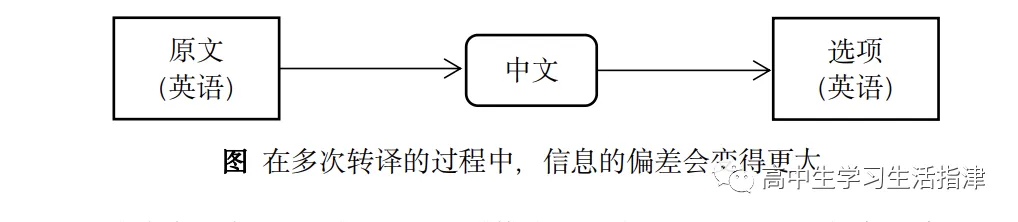 因此,我崇尚形成一种“意会”的思维模式,即尽量不做翻译,而是直接进行英语与英语的信息交流,这样就会尽可能减少信息转述过程中的偏差。同时,学习词汇时,也要英文释义。一个典型的例子就是adventure这个单词——曾经有一篇完形填空(原文暂未找到,但并非2022年新高考Ⅰ卷),讲述了主人公经历的一件事,最后总结此事为一次“adventure”,很多人就不解:这件事怎么能叫“冒险”呢?事实上,如果直接采用中文释义“冒险”和我们通常对“冒险”一词的理解,主人公的经历确实算不上adventure,因为似乎并没有发生惊险的事;但adventure在牛津字典上的英文释义是“an unusual, exciting or dangerous experience, journey or series of events”,可以看出,它的英文词义比中文“冒险”一词要广不少,而完型中人物的经历显然是符合“an unusual experience”的定义的。这是一个典型的语言不可通约性的例子,启发我们通过减少转译降低信息的失真。网络上有一些“整活”案例,把某篇文章在谷歌翻译中翻译20遍之后,就会出现离谱的结果,让观众捧腹大笑的同时,也恰恰显示了“信息失真”的威力。
上文提及选项信息与原文信息的四种关系,第一种“基本相同”几乎不会出现,第二种“同义替换”则是最高频的考查点。下表是四篇阅读理解中涉及到的同义替换:
位置
| 原文表达 | 题目表达 |
| 第21题B项 | Weoffer the newest bicyclesin a widevariety,… | It offersmany typesofbikes. |
| 第23题设问 | Thetourdeparts fromDam Square everyhour on thehour, starting at 1:00 pm every day. | Where does the guided city tourstart? |
| 第27题A项 | Then you let these new systems develop their own waystoself-repair. | Nature canrepairitself. |
第28题B项
| Thegoalof this book is tomake the case for digital minimalism,… | Advocatinga simple digital lifestyle.
|
| 第29题A项 | This process requires you tostep away fromoptional online activities for thirty days. | Clear-up. |
| 第31题A项 | You can view these practices asa toolbox meant to aid your effortsto build a minimalist lifestyle that words for your particular circumstances. | Use them as needed. |
破解同义替换需要我们的词汇与表达非常扎实,最好在习作中也能灵活运用多种表达方式表达同样的意思。
但同义替换仍然停留于字面含义,而概括提炼则更进一步。如第21题将MacBike的诸多服务概括为advantage,第24题将John提出一系列问题概括为他拥有一颗inquiring mind的表现,第26题将John的新方法在两地的实践概括为application,第30题将书中许多亲历者的经历概括为practical examples,第32题将现象背后的复杂原因概括为underlying logic,第33题将实验参与者之间可以交流概括为not fully independent,第34题将受试者一系列可做的事概括为discussion process。
迁移运用是最高的要求,包括了行文逻辑的理解和情感态度的把握,这些是在字面上难以直接获取的。第25、27题就要求我们把握事件中人物的行为逻辑,第35则要求我们把握作者的观点态度。前者需要我们理解文章的整个逻辑链,后者则需要我们品味出字里行间的情感态度。
(二)我们做什么
既然高考题提出了四个层面的能力要求,也恰是英语作为一门语言来说,阅读所需要的能力,因此我们要有相应的办法提高这些能力。
首先仍然是基本的词汇、表达和语法。这是我们掌握更高层次能力的基础,正所谓“基础不牢,地动山摇”,务必扎实掌握这些基本功,毕竟看懂阅读材料才是王道。学习一门语言,记忆工夫不可或缺。但正像上文提出的“信息失真”理论表明的,转译的路径越长,信息的偏差就越大,因此无论平时的背诵还是做阅读理解,都要培养由英语直接到英语的思维模式,尽可能避免中文的介入。
其次是概括能力。以前浙江卷还有一种写作题型是概要写作,虽然现在已经没有了,但是对概括能力的考查没有缺失。我认为概要写作的想法是可以借鉴的——我们可以变被动为主动,不妨自己尝试概括一些文段或文章的内容、给文章拟标题、概括人事物的特征等等。这也相当于命题的过程,从功利的角度讲,能够把握命题规律,那么做题自然也不在话下。
最后是逻辑和情感的把握。这其实不是独属于英语的命题——逻辑是任何学科都需要具备的,情感则是任何与交流有关的话题所涉及的。因此培养这个层次的能力并不局限于英语这门学科,甚至不局限于学习。生活也具备逻辑与情感,这是伴随人一生的命题。因此试题对这个层次能力的考查,也正是高考“立德树人”宗旨的体现。
下期预告:七选五、完形填空、语法填空试题分析
往期回顾:
语文|新高考古诗词鉴赏专题探究
数学|2023年普通高等学校招生全国统一考试模拟试题