(Text 1)问路
W: Could you please tell me how I can get to the student dorm building?
M: Sure. Turn left when you walk out of this register office. Pass the bookstore and you’ll see it.
(Text 2) 天气和季节
M: We couldn’t ask for a better day, could we, Barbara?
W: I know, Steve. There isn’t a cloud in the sky. I love this time of year.
M: Me too. The flowers are beautiful but calling for rain though.
(Text 3) 周末计划
M: We got any plans this weekend?
W: We might start with our vegetable garden, then the barbecue.
M: Sounds fun, but I still want to go fishing with George.
(Text 4)谈论偶遇老同事
M: Lisa, I saw Jack this morning.
W: You mean the former designer of our company? What’s he doing these days?
M: He said he’s got a new job as an art reporter.
(Text 5)参加学生会和社团活动
W: Do you often go to the student union, Andrew?
M: Pretty much. Once in a while I meet friends there, and I spend a lot of time organizing activities in different clubs or associations.
(Text 6)看房子
W: What do you think, Terry?
M: Well, it has one more bedroom than the last flat and the sitting room is big.
W: But there is not enough cupboard space in the kitchen.
M: It’s cheaper than the last one we saw and it is in a good neighborhood.
W: Well, maybe we’ll have to see if the agent has anything else to show us.
(Text 7)电台采访
M: Thank you, Mrs. Johnson, for what you’ve shared with our listeners. Now, please tell us, do you sometimes feel worried about your daughter, now that she’s grown up?
W: Oh, I worry about her like all parents do. After she graduated from medical school, she went to volunteer medical service in Africa.
M: Wow!
W: That’s okay if communication was fine. But if there was no Internet or telephone connection, we could sometimes go two weeks without getting in touch with each other. That often worries me.
(Text 8)求职面试
W: Now, sell yourself in a minute please.
M: I graduated from university two years ago, and have since been working in an accounting company. Apart from the knowledge and skills related to my major, I’m really good with computers. I have a large amount of experience working with big data. I think I’m well qualified for the accountant position here.
W: Good! Why did you choose this company?
M: Peterson has been my dream company all along. You value progress and focus on the quality of work more than the quantity. The flexible working hours and working from home is also attractive.
W: Ah huh. What do you think is your biggest weakness?
M: Well, when I work, I often concentrate so much on what I’m doing that I may have a hard time dealing with things that come up unexpectedly. That may be annoying to some people.
W: All right. Thank you very much.
(Text 9 )爱上阅读
W: So Robert, I guess you must be well into your third decade as a writer. How is life treating you?
M: Fourth decade as a writer. Hmm, let me get my calculator out. Well, I guess I’ve been writing novels since the 1980s. So you’re right. But I have been writing all my life. And to answer your question, life has been treating me excellently.
W: Can I ask you about your childhood? Were you a bookish child?
M: In a strange way, I was a non-reader until I turned nine. I used to play basketball in the schoolyards of Brooklyn. My father was a high school teacher of physics and chemistry. And he was a big reader. He would bring books back from his high school library. One day, I read the last chapter of a book, the title of which I’ve long since forgotten. I liked it so much that I started reading the remainder. Interestingly, I read the chapters backwards until I got to the beginning. I really loved the experience, and I soon became an eager reader. Then my father would bring piles of books home from the library. And I would read them all, and they were all fiction. I must add that I started reading the books from the start, as opposed to working backwards.
(Text 10)音乐比赛与艺术追求
M: Hello, I’m Maxim Vengerov, and I’m very happy to share with you my connection with open Tchaikovsky competition. It was June 1986 when I came to Moscow to participate in open Tchaikovsky competition at the age of 10 from Chelyabinsk. This was actually the turning point of my life. Then I attended a world music festival in Berlin. And it was interesting to say that a kid made his breakthrough already at the age of 10. And that was me. Now as a judge of the competition, I can see clearly the huge challenges facing the musicians in the competition. Where else can you see young players playing within ten days classical works and Russian traditional music before coming to the final stage? As a musician, it’s important to give maximum attention and time to your own reflections of your own feelings. So, what I’m really looking for in the competition is to meet someone who can touch me musically. I want to see the seed, at least the seed of the great tree that can grow. I would go for this violinist. I would go for this musician.
征文:写一位中国古代历史人物的人物简介和事迹,还有得到的启示和感悟。
——————————————————————————————————————————————————————————————————————————————书面表达(作文)真的一点都不难,高考版和时文这么多素材,随便看看,真的不会词穷
请以向学校英文报投稿的方式,用英语描述学习一项新技能的经历,及从中获得的体验和感受。
1、学的新技能是什么;
2、分享心得感悟。
注意:
1、词数 100 左右;
2、题目和首句已为你写好。
写作第一节:
假定你是李华,你校外教Ryan要举办口语培训班,将练习口语的所有学生,随机挑选两个人分成一组练习,你对此有意见,向外教写一封邮件,内容如下:
注意:
1、写作词数应为80左右;
2、请按如下格式在答题卡的相应位置作答。
第二节:读后续写
(考生回忆版)巴西男孩参加写作比赛:老师建议男主去写作,男主一开始不愿意,后面答应了并认真构思,最终获奖。
题源
文字版
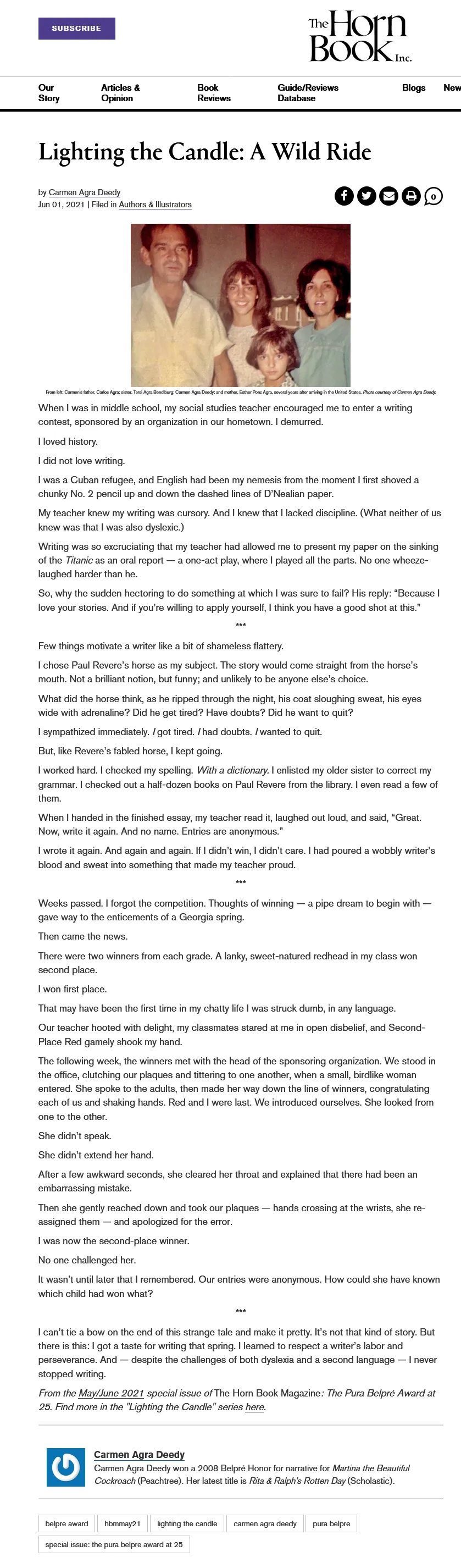
When I was in middle school, my social studies teacher encouraged me to enter a writing contest, sponsored by an organization in our hometown. I demurred.
I loved history.
I did not love writing.
I was a Cuban refugee, and English had been my nemesis from the moment I first shoved a chunky No. 2 pencil up and down the dashed lines of D’Nealian paper.
My teacher knew my writing was cursory. And I knew that I lacked discipline. (What neither of us knew was that I was also dyslexic.)
Writing was so excruciating that my teacher had allowed me to present my paper on the sinking of theTitanicas an oral report — a one-act play, where I played all the parts. No one wheeze-laughed harder than he.
So, why the sudden hectoring to do something at which I was sure to fail? His reply: “Because I love your stories. And if you’re willing to apply yourself, I think you have a good shot at this.”
***
Few things motivate a writer like a bit of shameless flattery.
I chose Paul Revere’s horse as my subject. The story would come straight from the horse’s mouth. Not a brilliant notion, but funny; and unlikely to be anyone else’s choice.
What did the horse think, as he ripped through the night, his coat sloughing sweat, his eyes wide with adrenaline? Did he get tired? Have doubts? Did he want to quit?
I sympathized immediately.Igot tired.Ihad doubts.Iwanted to quit.
But, like Revere’s fabled horse, I kept going.
I worked hard. I checked my spelling.With a dictionary.I enlisted my older sister to correct my grammar. I checked out a half-dozen books on Paul Revere from the library. I even read a few of them.
When I handed in the finished essay, my teacher read it, laughed out loud, and said, “Great. Now, write it again. And no name. Entries are anonymous.”
I wrote it again. And again and again. If I didn’t win, I didn’t care. I had poured a wobbly writer’s blood and sweat into something that made my teacher proud.
***
Weeks passed. I forgot the competition. Thoughts of winning — a pipe dream to begin with — gave way to the enticements of a Georgia spring.
Then came the news.
There were two winners from each grade. A lanky, sweet-natured redhead in my class won second place.
I won first place.
That may have been the first time in my chatty life I was struck dumb, in any language.
Our teacher hooted with delight, my classmates stared at me in open disbelief, and Second-Place Red gamely shook my hand.
The following week, the winners met with the head of the sponsoring organization. We stood in the office, clutching our plaques and tittering to one another, when a small, birdlike woman entered. She spoke to the adults, then made her way down the line of winners, congratulating each of us and shaking hands. Red and I were last. We introduced ourselves. She looked from one to the other.
She didn’t speak.
She didn’t extend her hand.
After a few awkward seconds, she cleared her throat and explained that there had been an embarrassing mistake.
Then she gently reached down and took our plaques — hands crossing at the wrists, she re-assigned them — and apologized for the error.
I was now the second-place winner.
No one challenged her.
It wasn’t until later that I remembered. Our entries were anonymous. How could she have known which child had won what?
***
I can’t tie a bow on the end of this strange tale and make it pretty. It’s not that kind of story. But there is this: I got a taste for writing that spring. I learned to respect a writer’s labor and perseverance. And — despite the challenges of both dyslexia and a second language — I never stopped writing.
From the May/June 2021 special issue ofThe Horn Book Magazine: The Pura Belpré Award at 25.Find more in the "Lighting the Candle" series here.
2023年新高考I卷阅读理解D篇
题源

文字版
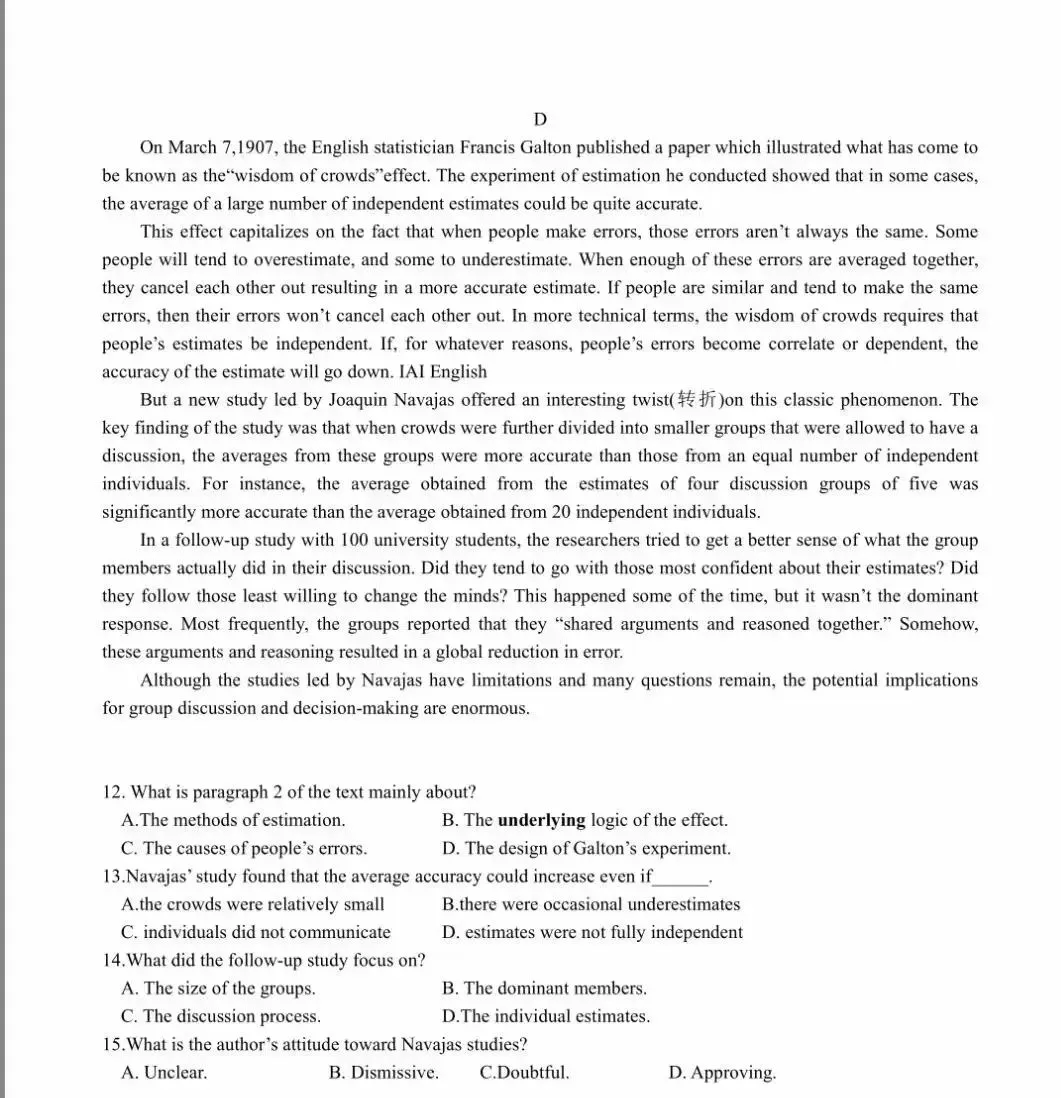
No Man Is An Island: The Wisdom Of Deliberating Crowds
On March 7, 1907 — almost 111 years ago to the day — the English statistician Francis Galton published a peculiar observation.
At a county fair held in Plymouth, 800 visitors had participated in a competition to guess the weight of an ox. While most people's estimates were too high or too low — falling an average of 37 lbs. away from the true weight of 1,198 lbs. — the median of everyone's guess was off by only 9 lbs., or less than 1 percent of the true weight of the ox.
This example illustrates what has come to be known as the "wisdom of crowds" effect. In some cases, the average of a large number of independent estimates can be quite accurate, even when the estimators have no special expertise.
"The average competitor," Galton wrote of the ox competition, "was probably as well fitted for making a just estimate of the dressed weight of the ox, as an average voter is of judging the merits of most political issues on which he votes."
The wisdom of crowds capitalizes on the fact that when people make errors, those errors aren't always the same. Some people will tend to overestimate, and some to underestimate. When enough of these errors are averaged together, they cancel each other out, resulting in a more accurate estimate. That's why the effect benefits from a large and diverse "crowd." If people are similar in the sense that they tend to make the same errors, then their errors won't cancel each other out. A crowd with many overestimators will yield a global average that still falls too high; a crowd with many underestimators will yield a global average that still falls too low.
In more technical terms, the wisdom of crowds requires that people's estimates beindependent. Studies have found that when people can observe the estimates of others, the accuracy of the crowd typically goes down. People's errors become correlated ordependent, and are less likely to cancel each other out. We follow our peers, to the detriment of the performance of the group.
But a new paper offers an interesting twist on this classic phenomenon. When crowds are further subdivided into smaller "crowds" that are allowed todeliberateabout the right answer, they not only succeed in overcoming the costs of introducing dependence, but even outperform the group as a whole.
The new paper, published last month inNature Human Behaviorand authored by Joaquin Navajas and colleagues, reports the results of a large-scale study of estimation. More than 4,000 people attending an event were asked to provide estimates for eight values, such as the height of the Eiffel Tower. They were then subdivided into groups of five estimators and encouraged to discuss half of the eight values to arrive at a consensus estimate for the group.
The key finding was that the averages from these "deliberating crowds" of five were more accurate than those from an equal number of independent individuals. For instance, the average obtained from the estimates of four deliberating groups of five was significantly more accurate than the average obtained from 20 independent individuals. In fact, averaging four deliberating groups resulted in a more accurate estimate than averaging1,400individual estimates.
These benefits were not observed for the estimated values that were not discussed by the group, so they somehow derived from the group-level process itself. But what, exactly, were the groups doing to achieve this impressive effect?
In a follow-up study with 100 university students, the researchers tried to get a better sense of what the deliberating crowds actually did. Did they tend to go with the answers of those who were most confident about their estimates? Did they gravitate towards the answers of those least willing to change their minds? This happened some of the time, but it wasn't the dominant response. Most frequently, the groups reported that they "shared arguments and reasoned together." Somehow, these arguments and reasoning resulted in a global reduction in error, rather than introducing correlated errors that undermined the wisdom of crowds.
The new paper by Navajas and colleagues reports only two studies, one large and one small, and it focuses exclusively on estimates concerning trivia or general knowledge. As a result, many questions remain. But the potential implications for group decision-making and deliberation are enormous. If a small number of deliberating groups can outperform a much larger number of individuals, this suggests that procedures like "deliberative polling" could be a promising strategy for public and private communities to pursue.
Galton introduced his 1907 paper by noting that "[i]n these democratic days, any investigation into the trustworthiness and peculiarities of popular judgments is of interest."
More than 111 years later, this interest most certainly remains.
2023年新高考I卷语法填空
题源
文字版
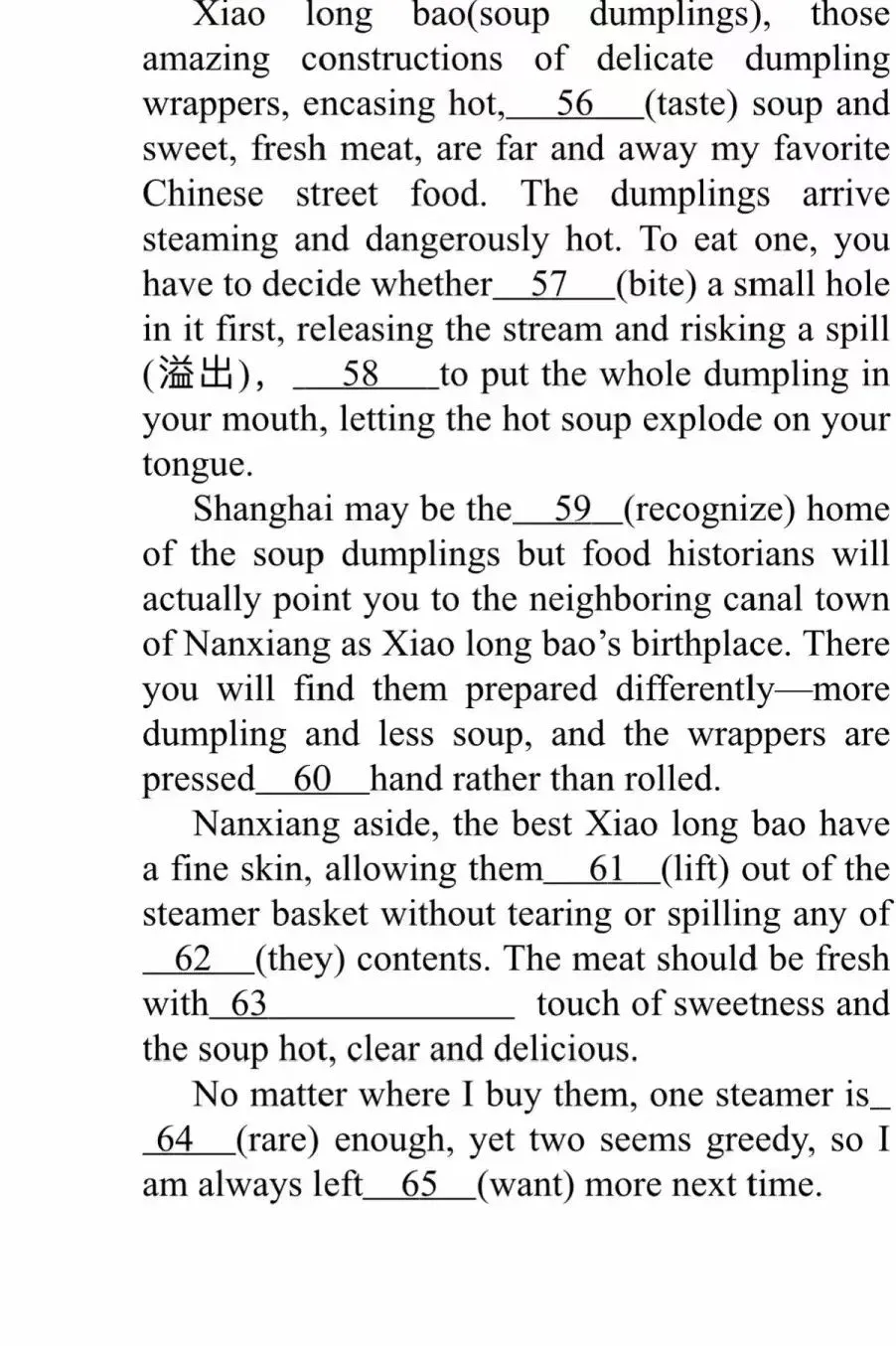
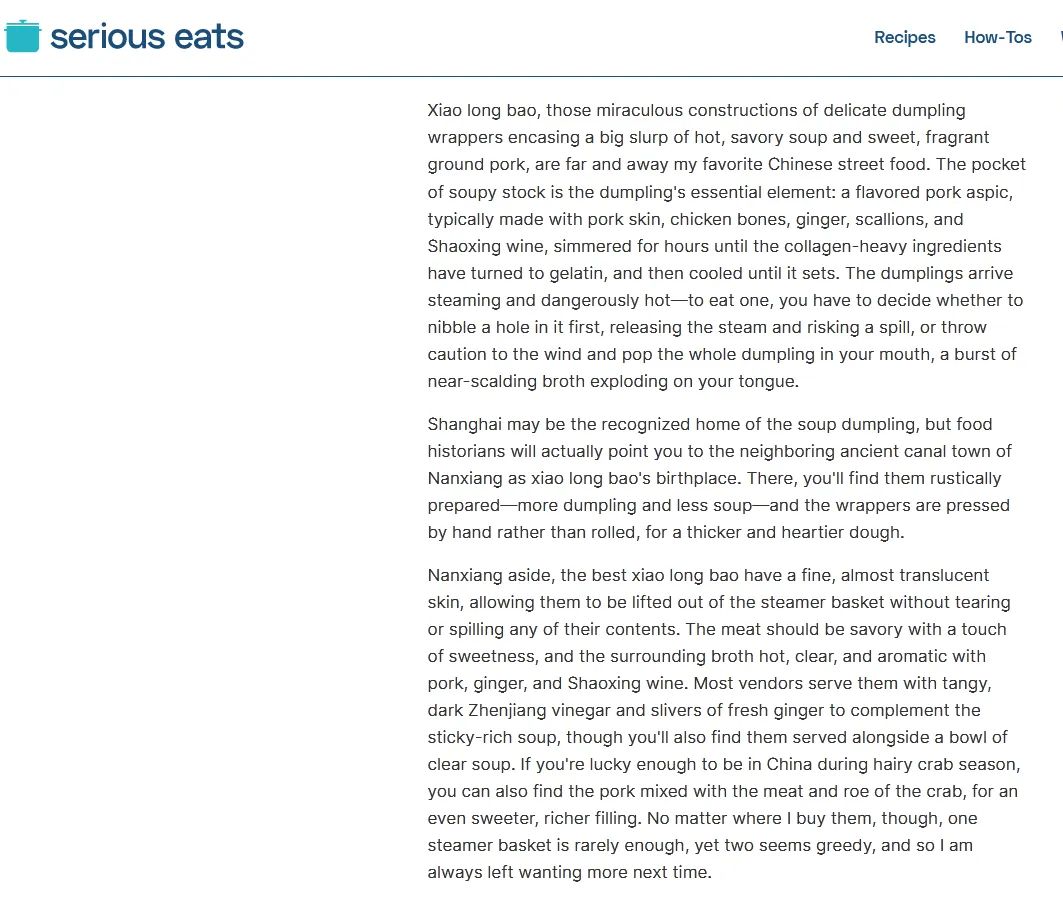
Xiao Long Bao (Soup Dumplings) Xiao long bao, those miraculous constructions of delicate dumpling wrappers encasing a big slurp of hot, savory soup and sweet, fragrant ground pork, are far and away my favorite Chinese street food. The pocket of soupy stock is the dumpling's essential element: a flavored pork aspic, typically made with pork skin, chicken bones, ginger, scallions, and Shaoxing wine, simmered for hours until the collagen-heavy ingredients have turned to gelatin, and then cooled until it sets. The dumplings arrive steaming and dangerously hot—to eat one, you have to decide whether to nibble a hole in it first, releasing the steam and risking a spill, or throw caution to the wind and pop the whole dumpling in your mouth, a burst of near-scalding broth exploding on your tongue.Shanghai may be the recognized home of the soup dumpling, but food historians will actually point you to the neighboring ancient canal town of Nanxiang as xiao long bao's birthplace. There, you'll find them rustically prepared—more dumpling and less soup—and the wrappers are pressed by hand rather than rolled, for a thicker and heartier dough.Nanxiang aside, the best xiao long bao have a fine, almost translucent skin, allowing them to be lifted out of the steamer basket without tearing or spilling any of their contents. The meat should be savory with a touch of sweetness, and the surrounding broth hot, clear, and aromatic with pork, ginger, and Shaoxing wine. Most vendors serve them with tangy, dark Zhenjiang vinegar and slivers of fresh ginger to complement the sticky-rich soup, though you'll also find them served alongside a bowl of clear soup. If you're lucky enough to be in China during hairy crab season, you can also find the pork mixed with the meat and roe of the crab, for an even sweeter, richer filling. No matter where I buy them, though, one steamer basket is rarely enough, yet two seems greedy, and so I am always left wanting more next time.
这篇文章选自serious eats的一篇长文章
What to Eat in China: A Traveler's Guide
Updated Oct. 30, 2019
(考生回忆版)作为交换生去英国学校,学校要办一个促进中英文化交流的活动叫 Chinese workshop 活动内容包括中国美食手工艺品和书法,并且活动有一项是教别人做中国传统的东西,写申请信:声明:本文来自网络。以上图、文、视频,贵在分享,版权归原作者及原出处所有,内容为作者观点,并不代表本gongzhong号赞同其观点和对其真实性负责。如涉及版权等问题,请及时与我们联系.